Entering on the first break or rounding 1.89 R to 2 R to make a trade fit the rule.
03 / AMT Setups
Return to value or accepted breakout?
Two situations can look similar on the first move beyond VAH. Rejection takes price back into value; acceptance builds activity outside. The book separates these scenarios and their invalidation.
What you need to understand
Return scenario
In a balanced context, price exceeds a boundary and returns inside. The scenario considers rotation toward POC and possibly the other boundary. Sustained trade and new volume outside contradict it.
Continuation scenario
The book calls for a break, acceptance and a boundary retest. A sustained return into the old balance invalidates the proposed continuation. Its timing thresholds are study rules, not universal laws.
Calculate before accepting a setup
The book’s example uses a hypothetical short at 5,216, stop at 5,234, POC at 5,200 and second target at 5,182. Risk is 18 points. The first potential gain is 16 points, or 0.89 R; the second is 34 points, or 1.89 R before costs. It is not exactly 2 R.
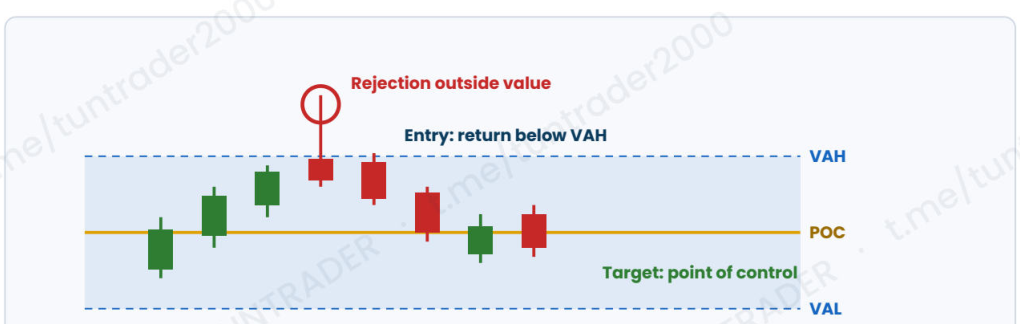
Worked example
If your rule requires at least 2 R, this example fails it even before costs. Taking partial profit at POC changes the combined outcome again. Check the arithmetic rather than accepting a setup because the diagram looks convincing.
Write context, trigger, invalidation and targets, then calculate the weighted outcome of planned exits. Reject a scenario that fails the criteria.
Simulation exercise
Review ten examples in replay, separating return-to-value and continuation. Calculate actual reward-to-risk before and after costs. Include cases with no qualifying entry.
Source: TUNTRADER book — Wajdi Mansour, PDF file pages: 49, 50, 51, 52, 53, 54.
Content summarized and adapted for the site, with calculations made explicit. Examples are not current recommendations.
Open the passage in the book ↗